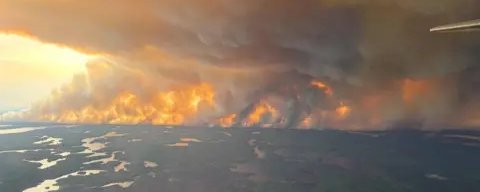
Wildfires in Canada and California will keep getting worse, and neither side’s favorite explanation — “bad forest management” (right) or “climate change” (left) — tells the whole story, argues “Dr. Platimus”.
— Dr. Platimus (@SWGaspar) July 17, 2026
The real argument he says is that many forests are naturally adapted to burn, and fire has shaped landscapes for hundreds of millions of years. Active management — controlled burns, harvesting, fuel reduction — is how humans have historically kept those natural cycles from becoming catastrophic, and it worked well for decades. But that progress stalled in part due to legal challenges from environmental groups, especially Sierra Club v. Bosworth (2007), which made it easier for a single rare species finding to block fuel-reduction projects under NEPA/ESA-style reviews.
The result, he argues, is bigger, more destructive fires — ironically undermining the ecosystems and climate outcomes these lawsuits aim to protect (citing Canada’s 2023 wildfires as a top global carbon source despite its small population).
Canada's 2023 wildfires released more carbon than the entire economies of seven of the world's ten largest emitters. Nearly four times global aviation.
— Resource Works (@Resource_Works) July 17, 2026
Meanwhile B.C. has deferred harvest across millions of hectares, closed 21 mills since 2023 and lost 15,000 forestry jobs.…
Shut it with the climate alarmism
A new data-driven analysis is challenging the popular narrative that climate change is fueling Ontario’s wildfires through rising heat and drought. The analysis comes from Chris Martz, a meteorologist known for digging into raw observational data rather than relying on model projections or secondhand talking points. Pulling records from over a century of Canadian weather stations, he found no evidence of a meaningful long-term increase in heatwave frequency — if anything, the past six decades have seen slightly fewer heatwave days than the preceding fifty years, and the shift isn’t statistically significant. While the past several years stand out, he cautions against treating a short recent stretch as proof of a lasting trend rather than normal year-to-year swings.
The drought picture tells a similar story. Cross-referencing decades of drought severity data with modern monitoring standards turned up no significant worsening trend — and even a notable decline in the most extreme drought category, a recent spike notwithstanding.
The takeaway: claims linking Ontario’s wildfires to worsening heat and drought don’t survive contact with the long-term observational record, regardless of how sound the underlying physics of warming may be in theory — a reminder that in a field crowded with model-based forecasting, Martz’s willingness to build datasets from scratch and test claims directly against the numbers stands out.
We are being told that the wildfires in Ontario are being driven / fueled by climate change. Specifically, more extreme heat and increased drought. So, unlike the journalists and most meteorologists regurgitating these talking points, I looked at the actual data since 1910.
— Chris Martz (@ChrisMartzWX) July 17, 2026
The… pic.twitter.com/Opuz2Kx64J
It’s not all about Forestry but it might be about priorities
There are ~9,000 times as many trees in Canada as people. Most of the forest is highly inaccessible, far from any towns or roads. Any kind of large-scale active forest management is unrealistic in Canada, and firefighting is mostly limited to the small portion near inhabited areas. These forests are of a type typically referred to as “fire climax forests”. That means they grow to maturity until natural forest fires regularly and periodically sweep through them, destroying the young, weak, diseased, and dead trees, while clearing out understory shrubs.
The Canadian Wildland Fire Information System currently lists 950 active fires (230 with burnt area >10 km²), distributed widely across Canada's forests.
— Dr. Robert Rohde (@RARohde) July 18, 2026
Smoke can be transported long distances, though fires near Canada's southern border are more likely to affect the USA. pic.twitter.com/VeYkGKiyE7
Canada's 2023 wildfires released more carbon than the entire economies of seven of the world's ten largest emitters. Nearly four times global aviation.
— Resource Works (@Resource_Works) July 17, 2026
Meanwhile B.C. has deferred harvest across millions of hectares, closed 21 mills since 2023 and lost 15,000 forestry jobs.…
Canada has oodles of money for Zelensky. In fact we have spare change for Brazil. But when the focus is on our forests we hear: they’re too darn big, or climate change, or that’s the way the ball bounces. But there are things we should do.
— Bluehart 🇨🇦🏴🍎🐠✝️ (@Bluehart007) July 17, 2026
Is Canada doing enough regarding… pic.twitter.com/SxlpEVz8QT
A good time to remember – Follow the Money
Alarmism and keeping us (especially the youth) scared have worked out well for many.
In 2006, Al Gore released An Inconvenient Truth, a film that defined modern climate alarm.
— Electroverse (@Electroversenet) July 1, 2026
He warned Greenland and Antarctica's ice would melt, driving seas high enough to put major cities underwater, saying that entire coastlines would have to be redrawn.
Eighteen years later… pic.twitter.com/KLO8eRbVC0