While the heat builds across large parts of the country this week, the usual headlines are already rolling in linking it straight to climate change. But ask an actual meteorologist what’s driving it, and you’ll get a much more specific, much less politically loaded answer.
A major heatwave will begin next week across the central and eastern U.S.
— Chris Martz (@ChrisMartzWX) June 27, 2026
High temperatures in the 90s and 100s are likely as far north as Southeastern Pennsylvania. So, summer basically lol.
Undoubtedly, there’ll be plenty climate hysteria to go around.
But neither the… pic.twitter.com/ykB6VtA8dN
What’s Actually Happening Over the US
This week’s heat is being driven by a strong upper-level ridge of high pressure — what forecasters commonly call a “heat dome” — building over the central and eastern United States. The setup is centered initially over the Ohio Valley, the Mississippi Valley, and the Tennessee Valley, before shifting toward the Great Lakes and East Coast by the Fourth of July, bringing widespread 90s and triple-digit heat indices from the Gulf Coast to the Midwest.
The mechanics are the same straightforward physics at work in Europe right now: a ridge of high pressure traps air beneath it, that air sinks, and as it sinks it compresses — a basic thermodynamic process that raises its temperature with zero involvement from greenhouse gases. The same ridge suppresses cloud formation, so skies stay clear and the sun does the rest of the work heating the surface day after day.
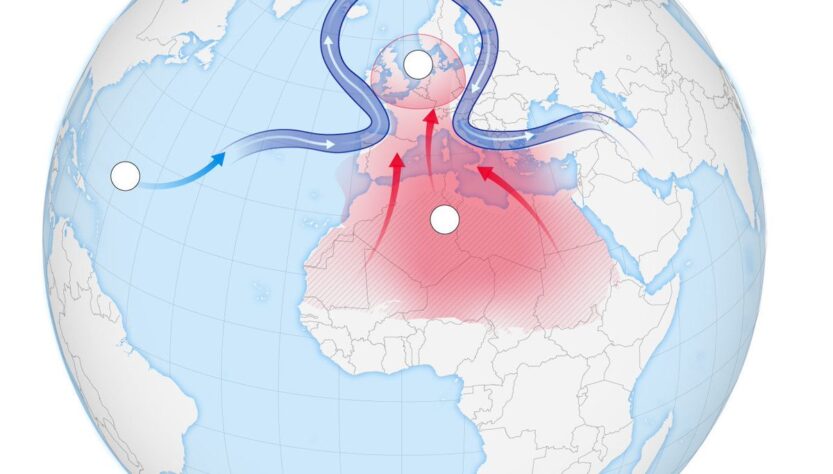
It’s worth being precise about terminology here: this US pattern is technically a heat dome rather than a true omega block. A heat dome is simply a ridge of high pressure sitting in place; an omega block is the more rigid, locked-in version of that, where the ridge is pinned between two low-pressure troughs in a shape resembling the Greek letter Ω, freezing the entire pattern so it can barely move for days or weeks. Europe’s current heatwave is being driven by exactly that locked Ω-shaped configuration. The US ridge, by contrast, is expected to drift slowly eastward over the course of the week rather than staying pinned in place — same family of phenomenon, same basic physics, but a looser, more mobile version of it.
Either way, the lesson is the same one playing out on both sides of the Atlantic: a well-documented, purely mechanical atmospheric process — not a CO2 molecule in sight — is what’s actually putting the heat on the thermometer this week.
What Is an Omega Blockade?
An omega blockade is a recognizable pattern in the jet stream — the high-altitude wind current that steers most of our day-to-day weather. The name comes from its shape: a tall ridge of high pressure in the middle, flanked by two troughs of low pressure on either side, forming something that looks like the Greek letter Ω.
That shape is the whole story. Once the ridge and the two troughs lock into position, the entire pattern stops moving. Normal weather systems get pushed along from west to east by the jet stream; an omega block jams that conveyor belt, so the same air mass sits over the same region for days, sometimes weeks.
Interessant verhaal over de omegablokkade.
— F̳̿͟͞l̳̿͟͞i̳̿͟͞c̳̿͟͞k̳̿͟͞ ™ (@Flick1_) June 27, 2026
Een meteoroloog legt uit waarom het deze week zo warm is (en nee, het komt niet door klimaat- verandering
De omegablokkade — dat is de werkelijke meteorologische verklaring achter de extreme temperaturen die momenteel over een groot… pic.twitter.com/PHx0auP76Y
Under the ridge, air sinks. As it sinks, it compresses, and compression heats air — a basic, well-understood physical process with nothing to do with greenhouse gases. That sinking air also suppresses cloud formation, so skies stay clear and sunlight reaches the ground largely uninterrupted. The combination of compressional heating and clear skies is what produces the extreme, multi-day temperature spikes associated with these blocks.
This is not some new or exotic phenomenon — it’s one of the most thoroughly documented features in synoptic meteorology, and it has produced major heatwaves going back through the entire instrumental record, long before anyone was talking about CO2.
A Meteorologist Pushes Back
Meteorologist Chris Martz has laid out this case in detail, arguing the current heat event tracks the omega-block pattern closely and would have produced similar record temperatures even in a pre-industrial atmosphere. Martz also raises a point that rarely makes it into mainstream coverage: some research suggests Arctic warming should, if anything, make blocking patterns like this less frequent, not more — because blocking is partly driven by the temperature contrast between the equator and the poles, and a warmer Arctic narrows that contrast. If that’s right, it cuts directly against the “climate change is intensifying these heatwaves” narrative rather than supporting it. Martz is careful to note this point is itself debated in the literature, not a settled slam-dunk — but it’s notable that the easy media narrative rarely acknowledges the question exists at all.
Why Are These Events Hitting More Often?
Martz also points to a less comfortable explanation for any apparent uptick in these events: cleaner air. Stricter air-quality regulations have meaningfully reduced atmospheric aerosols (particulates) over recent decades. Fewer aerosols means less low- and mid-level cloud formation, which means more direct sunlight reaching the surface and higher daytime highs. In other words, part of what’s driving more intense heat events may be the success of pollution-control policy — a far less click-friendly storyline than “fossil fuels are cooking the planet.”
The Media Pattern
Think tank Clintel, represented by science journalist Marcel Crok, has backed Martz’s read on this. The pattern by now is fairly predictable: a heatwave hits, outlets reach for the climate-change explanation almost reflexively, and the actual meteorological mechanism — the one a forecaster would actually point to on a weather map — gets a passing mention at best. Whatever you think about the broader climate debate, “what’s making it hot this specific week” has a specific, falsifiable answer, and it’s sitting right there in the upper-atmosphere wind pattern.