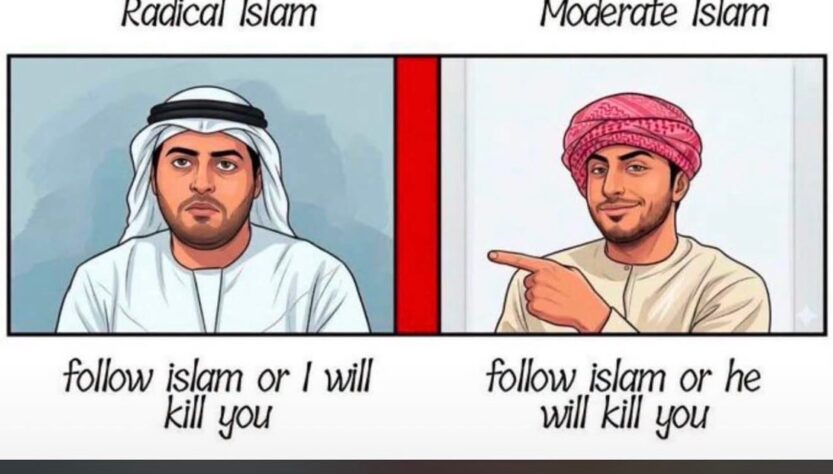
A new Pew Research Center poll has delivered a brutal dose of reality. Nearly half of American Muslims—44 percent—hold a favorable view of Hamas. That is not a fringe finding. It is the clearest number yet on how a significant share of the U.S. Muslim population regards a designated terrorist organization responsible for the October 7, 2023 massacre.
The survey of more than 12,000 adults, conducted in May 2026 with an oversample of Muslims, puts the figure at 44 percent. That is up from 37 percent in a comparable 2024 survey. Among Jews the number is 2 percent. White evangelicals sit at 4 percent. Catholics at 8 percent. The overall American public registers around 10 percent favorable. Muslims are the extreme outlier.
https://t.co/jHBd9kMBgu Nearly half of Muslim Americans expressed support for Hamas amid shifting American attitudes toward Israel and the Israeli-Palestinian conflict.
— SASSYCHICK (@KT07500539) August 10, 2026
What the Numbers Actually Show
Hamas is not a charity or a political party in the Western sense. It is a jihadist group whose charter and actions aim at the destruction of Israel and the murder of Jews. It has governed Gaza as a theocratic dictatorship, diverted aid into tunnels and rockets, and celebrated the slaughter of civilians. Favorable views of that organization among American Muslims stand in sharp contrast to every other major religious group in the country.
Earlier polling reinforced the pattern. In 2024, significant shares of Muslim respondents denied that Hamas committed murder and rape on October 7 or framed the attack as justified resistance. Sympathy for Palestinians runs high, as expected. Favorable views of the Israeli people among American Muslims sit at just 26 percent—far below every other group surveyed.
Implications for Muslims in America
American Muslims are not a monolith. Many are successful, law-abiding, and fully integrated. The 44 percent figure does not mean half the community is ready to join a terror cell. It does mean a large minority holds views that are incompatible with the basic moral consensus of the country they live in.
That gap raises hard questions about assimilation. When a community of several million people, concentrated in key electoral states and growing through immigration and higher birth rates, registers near-majority sympathy for a group that targets America’s closest Middle East ally and American citizens, the issue is not “Islamophobia.” It is whether large segments of that community share the same civilizational assumptions as the rest of the country.
Political power is following demographics. Muslim voters already swing outcomes in places like Dearborn and parts of Michigan. Progressive candidates who adopt maximalist anti-Israel positions have won primaries. As the community expands, those attitudes will exert more pressure on local and national politics. The risk is a permanent parallel political bloc that treats support for Israel as illegitimate and treats criticism of jihadist groups as bigotry.
This photo of Rashida Tlaib, Ilhan Omar, and Abdul El-Sayed celebrating that “200 Muslims have been elected since 2019” isn’t some cute diversity win.
It’s a warning. This is a demographic and political capture happening in plain sight, and it’s not good for America.
The…
— D. Luigi (@DLuigi23) August 9, 2026
What It Means for U.S.-Israel Relations
America’s relationship with Israel has rested on shared strategic interests, democratic values, and a broad bipartisan consensus. That consensus is eroding on the left, and Muslim public opinion is one of the drivers. Democratic politicians already face intense pressure from progressive and Muslim constituencies to condition or cut aid to Israel. Candidates who refuse to condemn Hamas or who describe Israeli self-defense as genocide are no longer fringe.
If these attitudes harden and grow with the population, future Democratic administrations will find it harder to maintain unqualified support for Israel. Republicans remain far more solid, but the overall political environment is shifting. The result could be more hesitant U.S. backing during the next crisis, more diplomatic isolation of Israel, and greater willingness to pressure Jerusalem into concessions that strengthen its enemies.
Hamas does not need American Muslims to fire rockets. It does benefit when a sizable share of a growing U.S. demographic treats its ideology as legitimate. The poll does not prove inevitable conflict. It does prove that polite silence about these numbers is a luxury the country can no longer afford.