America’s debt is not a number on a whiteboard. It is a pile of IOUs: bills, notes, and bonds sold to banks, funds, households, and foreign governments. The government pays interest on all of it. When borrowing gets more expensive, the interest bill grows. When the interest bill grows, Washington borrows again to cover it. That is the treadmill.
The way off the treadmill is not a speech. It is buyers. If more people want Treasuries, the government can sell them at lower yields. If fewer bonds sit in the open market, prices can rise and yields can fall. The world’s largest borrower still lives by supply and demand.
On September 3, two things landed on the same day.
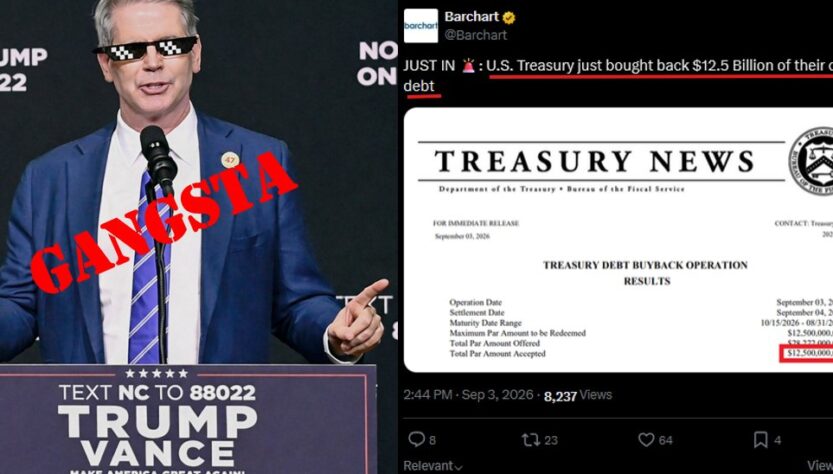
That afternoon, Treasury bought back $12.5 billion of its own short-dated securities. Dealers offered $28.3 billion. Treasury took the full cap. The operation was scheduled, not improvised. Buybacks are now routine: cash-management purchases at the front of the curve, liquidity support farther out, and a mid-August decision to at least double the size of long-end operations starting September 9.
That is one side of the market. The issuer buying its own paper.
The other side is newer. The GENIUS Act, the first federal law for dollar stablecoins, requires every permitted issuer to hold one dollar of reserves for every token in circulation. Those reserves are tightly defined and short-dated: cash, bank deposits, Treasuries with 93 days or less left to run, and qualifying overnight Treasury repo. The rule is meant to make tokens redeemable. The side effect is a standing bid for the front end of the Treasury market. A growing digital dollar is, in practice, a growing bid for short government paper.
That is the real “mandatory buyer” story. It is not that a consortium of banks woke up on September 3 and pledged $1.4 trillion of long bonds by 2027. The law does not work that way. It pulls demand into bills and other cash-like paper, not 10-year and 30-year coupons. The long end is a separate problem, which is why Treasury has been enlarging those buybacks on its own.
The overlap still matters. One department now manages the auctions, the buybacks, the license to issue a dollar token, and the compliance rules those issuers will live under. FinCEN and OFAC set the sanctions and anti-money-laundering bar. The OCC is the charter path for many of the firms that want in. The Fed no longer has to manufacture the bid the way it did in quantitative easing, when its balance sheet swelled from under $1 trillion to about $9 trillion. If the new rules work, private firms buy the bills with private money.
The week around September 3 made the shift obvious. At Jackson Hole, Fed Chair Kevin Warsh talked like a central banker with one job: set a policy rate. Days later in Asheville, Treasury Secretary Scott Bessent ran the G20 finance meetings. Jamie Dimon was in the room and said Treasury had given the private sector a seat at the table for the first time. That is not a plot. It is a change in who sets the tone for the plumbing of the debt market.
None of this erases $35 trillion. A $12.5 billion buyback is small against the stock of debt. Stablecoin reserves, even if they scale fast, crowd into the shortest paper and may recycle existing T-bill demand as much as they create new demand. Selling bills to fund buybacks does not retire the fiscal problem. It rearranges it.
🚨BOOM BOOM BOOM This morning Treasury created $1.4 trillion in mandatory bond buyers. This afternoon Treasury bought back $12.5 billion in bonds.
— TheDebriefing17 (@TheDebriefing17) September 3, 2026
The Government Just Played Both Sides of Its Own Market
Let me make this really simple.
The U.S. government owes $35 trillion.… https://t.co/EfH5eO0xBr pic.twitter.com/LSuGd8icmS
What changes is who sets the cost of carrying the debt. For a decade the answer was the Fed, buying duration with created reserves. The emerging answer is Treasury: rules that create a bid for short government paper, operations that pull selected securities out of the market, licenses that decide who can issue dollar tokens to American users, and sanctions that decide who is allowed inside the dollar system.
That is what September 3 showed. Not a trick that cheapened the entire debt stock before sunset. A reminder that the same department now sits on both sides of its market — writing the demand and managing the supply — and is no longer waiting for the central bank to do the buying.